Firehouse Subs Overview
Firehouse Subs opened its first restaurant on 10 October 1994 in Jacksonville, Florida, founded by brothers Chris and Robin Sorensen, both former firefighters and sons of a 43-year veteran of Jacksonville Fire and Rescue. Chris was 34 and Robin was 26. The pair started with less than $100 combined in their checking accounts, financing the shop with loans from family and friends, and later credited that early scarcity with shaping the company’s operating discipline.
Learn More Show Less
An initial attempt at franchising in 1995 was pulled back after the brothers judged their systems weren’t ready; they bought back the early franchised units and rebuilt the model from 2000 onward using outside consultants to plan controlled growth. That slower, process-led expansion took the chain from a single Jacksonville store to more than 1,200 US locations by the early 2020s. By the end of 2025 the chain reported 1,276 US restaurants, net growth of 47 units on the year, roughly $1.2 billion in US systemwide sales and an average unit volume of $960,000, with franchisee profitability per unit rising past $100,000.
In November 2021 Restaurant Brands International, owner of Burger King, Tim Hortons and Popeyes, agreed to acquire Firehouse Subs for $1.0 billion in cash; the deal closed on 15 December 2021. The brand retained its Jacksonville headquarters and its own management team inside RBI’s multi-brand structure, giving the Sorensens’ company access to RBI’s supply chain and franchising infrastructure while keeping its founder-led positioning intact in marketing.
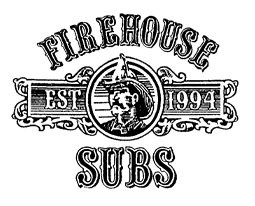
The visual identity has stayed close to its firehouse origins throughout. The earliest signage-style mark leaned heavily on fire-station iconography, including a uniformed firefighter figure, arched lettering and a vintage bar-sign feel. Subsequent revisions stripped out the human figure and straightened the lettering for legibility, while keeping a badge-like fire-hydrant motif as the enduring nod to the brand’s origin story. The current mark is a simplified red, black and gold badge built around the word “Firehouse”, used consistently across restaurant signage, packaging and digital assets; a refreshed logo file was in circulation by 2024.
Documented brand colours are a fire-engine red (#E03A3E), a near-black (#231F20) used for typographic contrast, and a gold/amber accent (#FDB925) that recalls fire-service badge detailing, set against white. The palette functions less as a designed-from-scratch scheme and more as a direct lift from American fire-service livery, reinforcing the founders’ occupational heritage rather than following restaurant-category convention (most competitors use warmer yellows or greens).
Advertising has moved through several agency relationships rather than one long-running campaign platform. Firehouse Subs hired Marc USA in early 2016 for its first major agency-led work, including spots such as “Innovation” and “Bells”, before switching to The Richards Group later that same year as the chain pushed a more aggressive unit-growth strategy. More recently, creative duties have sat with Orchard (lead creative) and Omnicom’s PHD (media), including a 2023-24 campaign bringing back the chain’s fan-favourite Hot Sauce Bar with darkly comic ads that drew coverage from Ad Age and Adweek. Across eras the throughline has been product-forward, slightly wry advertising rather than brand-philosophy storytelling.
Tone of voice draws directly on the founders’ fire-service background: proud without being sentimental, community-minded, and willing to use dry, self-aware humour (the Hot Sauce Bar ads leaned into mock-peril framing) rather than pure hero worship. Menu and in-store copy foregrounds portion size and flavour (“hearty”, “fully involved”) more than emotional appeals, keeping the firefighter connection present but understated in day-to-day marketing.
Competitively, Firehouse Subs sits in the US quick-service sandwich category alongside Subway, Jersey Mike’s and Jimmy John’s. Its differentiation is less about menu innovation and more about provenance and cause: a founder story rooted in actual fire service, and a dedicated charitable foundation that funds equipment for first responders, which none of its direct sandwich competitors replicate at the same scale or authenticity.
The lesson in Firehouse Subs’ growth is that a narrow, credible origin story, reinforced consistently through visual identity, charitable action and (more loosely) tone of voice, can substitute for aggressive menu differentiation in a crowded category. The brand’s discipline came less from marketing spend and more from controlled, consultant-guided franchise expansion after an early false start, a sequencing choice that shaped its financial profile enough to attract a $1 billion acquisition by RBI in 2021.